 AutoTrain ML
Input features
19 service, account, billing, and demographic fields
Build and compare customer churn classifiers using contract, service, tenure, and billing features.
This fixed setup makes the comparison understandable and repeatable. It is an example configuration, not an automatic recommendation for every dataset.
19 service, account, billing, and demographic fields
Coerce TotalCharges to numeric, impute missing values, standardize numeric columns, one-hot encode categories.
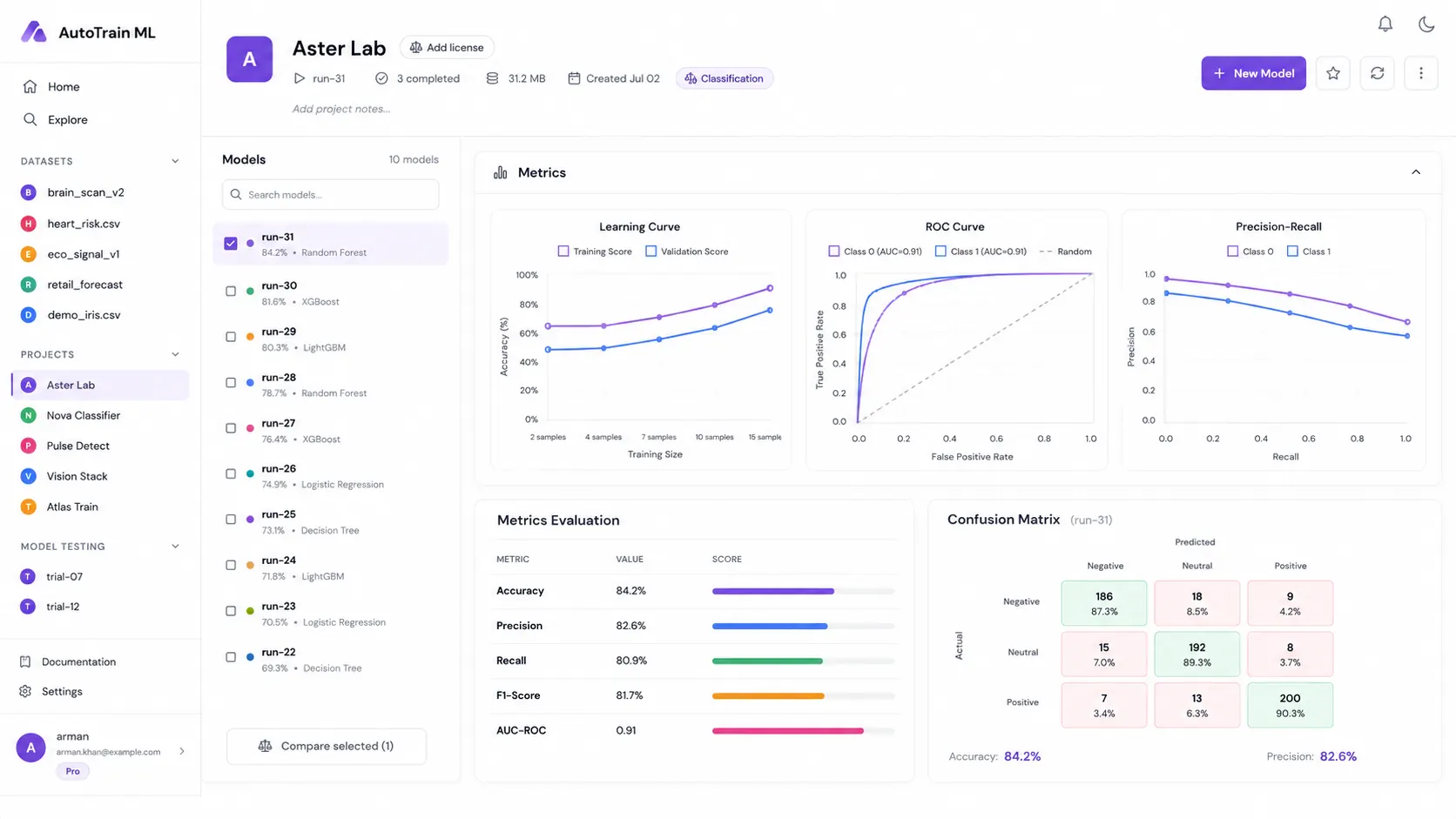
These values were computed with scikit-learn using the setup above. They show what one reproducible baseline looks like; they are not copied from the cited paper and are not a production guarantee.
F1 for churn class: 0.604, 0.535, and 0.589.
The two strongest accuracy values are tied, but Logistic Regression has the highest churn-class F1 in this fixed run. That makes it the clearer baseline here; a final choice should still compare recall, calibration, and retention cost.
Repeat validation on recent, representative data; review subgroup errors; define a fallback; and monitor input and outcome drift.
Use the prediction as evidence, not as the sole decision maker, where an error could affect education, health, access, pricing, or customer treatment.
Verbeke et al. (2012), New insights into churn prediction in the telecommunication sector, European Journal of Operational Research.
The journal reference provides methodological or domain context. AutoTrain's benchmark above is a separate implementation using the stated holdout configuration.
Open journal article